State and Reactivity
What is the state made for?
State allows you to keep track of UI-related data that is not directly related to the UI tree.
How it works - shortly
- A window (
DsglWindow) owns state and builds the DOM tree inrender() - A screen host (for example
DsglScreenHost) asks the window to rebuild when invalidated - Hook state is tracked by the per-window hook runtime
Two state models
Window-owned state: state(...)
Use this for a state owned by the whole window:
import org.dreamfinity.dsgl.core.DsglWindow
import org.dreamfinity.dsgl.core.dsl.UiScope
import org.dreamfinity.dsgl.core.dsl.button
import org.dreamfinity.dsgl.core.dsl.text
import org.dreamfinity.dsgl.core.event.Event
import org.dreamfinity.dsgl.mcForge1710.demo.examples.containers.centeredFlexWrapper

class GlobalStateWindow : DsglWindow() {
    private var counter by state(0)

    override fun render() = ui {
        centeredFlexWrapper {
            globalStateCounter(counter, { counter += 1 })
        }
    }
}

private fun UiScope.globalStateCounter(counter: Int, setCounter: (_: Event) -> Unit) {
    button("Increment", { onMouseClick = setCounter })
    text("Counter: $counter")
}
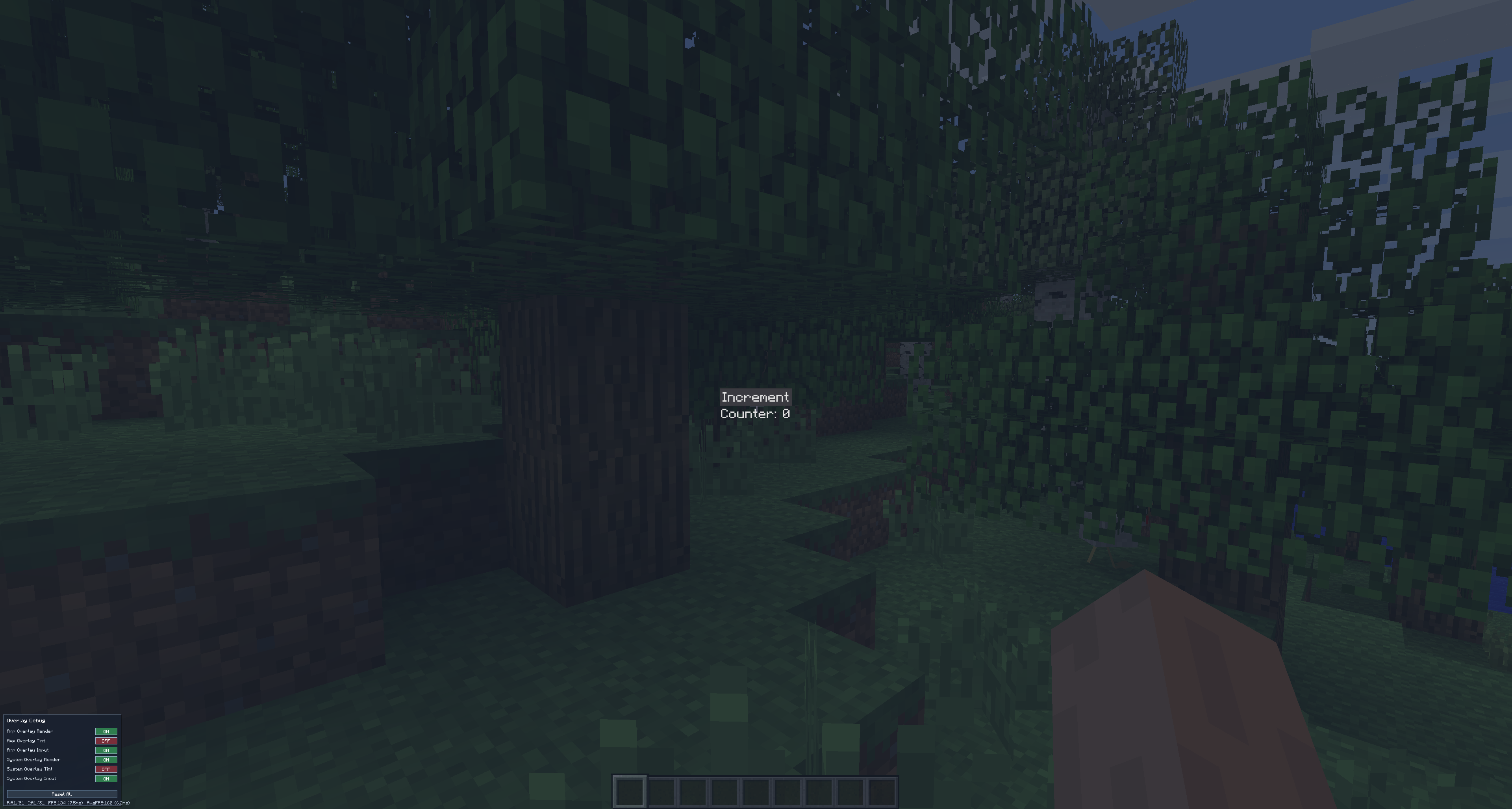
Behaviour in the current implementation:
state(...)returns a delegate-backed mutable state holder- Setting a different value triggers
invalidate() - With an attached host,
invalidate()requests rebuild viarequestRebuild("state") - Setting the same value does not request rebuild
This might be useful for window-wide state not tied to a specific component until a global state manager is implemented
Hook state: useState(...) and useReducer(...)
Use this for local state inside UiScope composition:
fun UiScope.counterCard() {
    var count by useState(0)
    val (sum, dispatch) = useReducer(0) { old: Int, delta: Int -> old + delta }

    button("count +1", { onMouseClick = { count += 1 } })
    button("sum +5", { onMouseClick = { dispatch(5) } })
    text("count=$count sum=$sum")
}
Behaviour in the current implementation:
useStateuses the same invalidation path asstate(...)(viawindow.onHookStateChanged())useReducerdispatch also uses that same path- Hook local state persists across rebuilds for the same component identity
- If a hook subtree disappears and later reappears, the hook state is reinitialized
Important usage rule:
- Storage-backed hooks must be used with delegated syntax (
by):useState,useMemo,useCallback,useRef - Direct assignment (without
by) fails at runtime with a hook usage error
What triggers rebuilds
var x by state(...)set to a different valuevar x by useState(...)set to a different valueuseReducerdispatch that changes reducer state- Explicit
invalidate()call from window code - Host-driven rebuild requests (for example, resize / hot-reload handling in
DsglScreenHost)
What does not trigger rebuild by itself:
- Reassigning the same value
- Mutating a mutable object in place without changing the delegated state value (because mutation is a bad UI patter, use reducers with clean functions instead)
useMemo,useCallback,useRef,useContextreads aloneuseEffectregistration alone (it runs after commit; rebuild happens only if effect code mutates state or calls invalidation through your code)
Commit semantics for effects
useEffect/useEffectEveryCommit are render commit-bound:
- Effects run after a successful render commit
- Dependency change clean-up runs before rerun
- Unmount/disappearance triggers clean-up
- Aborted/failed render attempts to do not run effect bodies and do not run dependency-switch clean-up for that aborted attempt
This is why effect behaviour can differ from immediate render-time logic
Best practices
- Keep window-wide state in
state(...)(until global state manager is implemented) - Keep component-local interactive state in
useState/useReducer - Use stable keys for interactive elements to preserve focus/state across rebuilds
- If you need a forced rebuild, expose a window method that calls
invalidate()instead of wiring host APIs directly into components
Next: Custom components.